
.png)
Most people expect menopause to arrive with some kind of announcement. What nobody really prepares you for is perimenopause—the years-long transition that can start well before you hit 40, and that can look completely different from one person to the next.
Your cycle gets weird. You wake up at 3 a.m. drenched in sweat. You forget words mid-sentence. You feel anxious for no obvious reason. And if you're like a lot of people, your first question is: is this normal?
Perimenopause typically starts in your mid-40s, though it can begin earlier. The transition lasts around four years on average, but can stretch up to a decade for some. A staggering 94% of women say they received no education about perimenopause in school. So if you feel caught off guard, that's the norm.
We’re here to help you through understanding what perimenopause actually is, what symptoms to expect (including some that rarely get talked about), and what you can do to feel better. Consider it the conversation you should have had years ago.
Perimenopause is the transitional phase that leads up to menopause. During this time, your ovaries gradually produce less estrogen and progesterone, but hormone levels don't drop in a smooth, predictable line. They fluctuate. Sometimes they spike. Sometimes they plummet. That hormonal inconsistency is what drives most of the symptoms you'll read about below.
These three terms get used interchangeably, but they describe distinct stages:
The early stage of perimenopause typically begins between ages 40 and 44, though some people may notice changes as early as their mid-to-late 30s. Perimenopause can begin as early as eight to ten years before menopause.
Timing varies because of genetics, lifestyle, and other factors. Smoking is a significant contributor, with current or former smokers experiencing menopause approximately 1-4 years earlier than non-smokers. Family history also plays a role—if your parent went through it in their mid-40s, there's a reasonable chance you will too. African American and Hispanic individuals tend to reach menopause around age 49, roughly two years earlier than the national median, and often report more severe vasomotor symptoms.
Perimenopause doesn't follow a script. Some people sail through with a few irregular cycles; others get hit with a full roster of symptoms that affect sleep, mood, energy, and sex drive all at once. These are the changes most commonly reported during the perimenopausal transition—and what they actually feel like day to day.
Changes in your cycle are often the first sign that perimenopause has started. But "irregular" covers a wide range—cycles that get shorter, cycles that get longer, periods that are heavier than usual, or months where your period just doesn't show up at all. The length of menstrual cycles may increase or decrease, and for most people, periods don't stop suddenly.
Any significant changes are worth discussing with a provider, particularly if you notice bleeding between periods or spotting after sex.
Hot flashes are probably the most well-known perimenopause symptom. They affect about 75% of women during this life stage. A hot flash typically comes on fast—a wave of heat that spreads through your chest, neck, and face, often followed by sweating and chills. Night sweats are essentially hot flashes that happen while you sleep, and they can be intense enough to wake you up repeatedly.
Poor sleep during perimenopause isn't always just about night sweats. Hormonal shifts can affect your ability to fall asleep and stay asleep even on nights when temperature isn't the issue. Over time, disrupted sleep compounds other symptoms like mood changes and brain fog, creating a cycle that can be genuinely hard to break without support.
If you've found yourself feeling more on edge, more tearful, or more anxious than usual, you're not imagining it. Perimenopausal individuals have a 40% higher risk for depressive symptoms or a diagnosis of depression compared to those who are premenopausal. Fluctuating estrogen directly affects serotonin and other mood-regulating neurotransmitters, which means emotional changes during perimenopause are physiological, not psychological weakness.
Forgetting why you walked into a room, losing your train of thought mid-conversation, struggling to concentrate—these are all common perimenopause signs. Estrogen plays a role in cognitive function, and as levels fluctuate, many people notice changes in memory and mental clarity. This tends to improve once hormone levels stabilize, but it can be disorienting while it's happening.
As estrogen declines, vaginal tissue can become thinner and less lubricated. This can make sex uncomfortable or painful, and it also increases susceptibility to urinary tract infections. Changes in libido—either decreased or, for some, increased—are also common and can stem from hormonal shifts, sleep disruption, stress, or a combination of all three.
Many people notice changes in body composition during perimenopause, particularly increased fat around the midsection. This isn't simply a matter of eating more or moving less. Declining estrogen affects how your body stores fat and regulates metabolism. 43% of menopausal women have obesity, driven by shifting body composition, activity levels, and the compounding difficulty of managing symptoms that make maintaining a healthy weight harder.
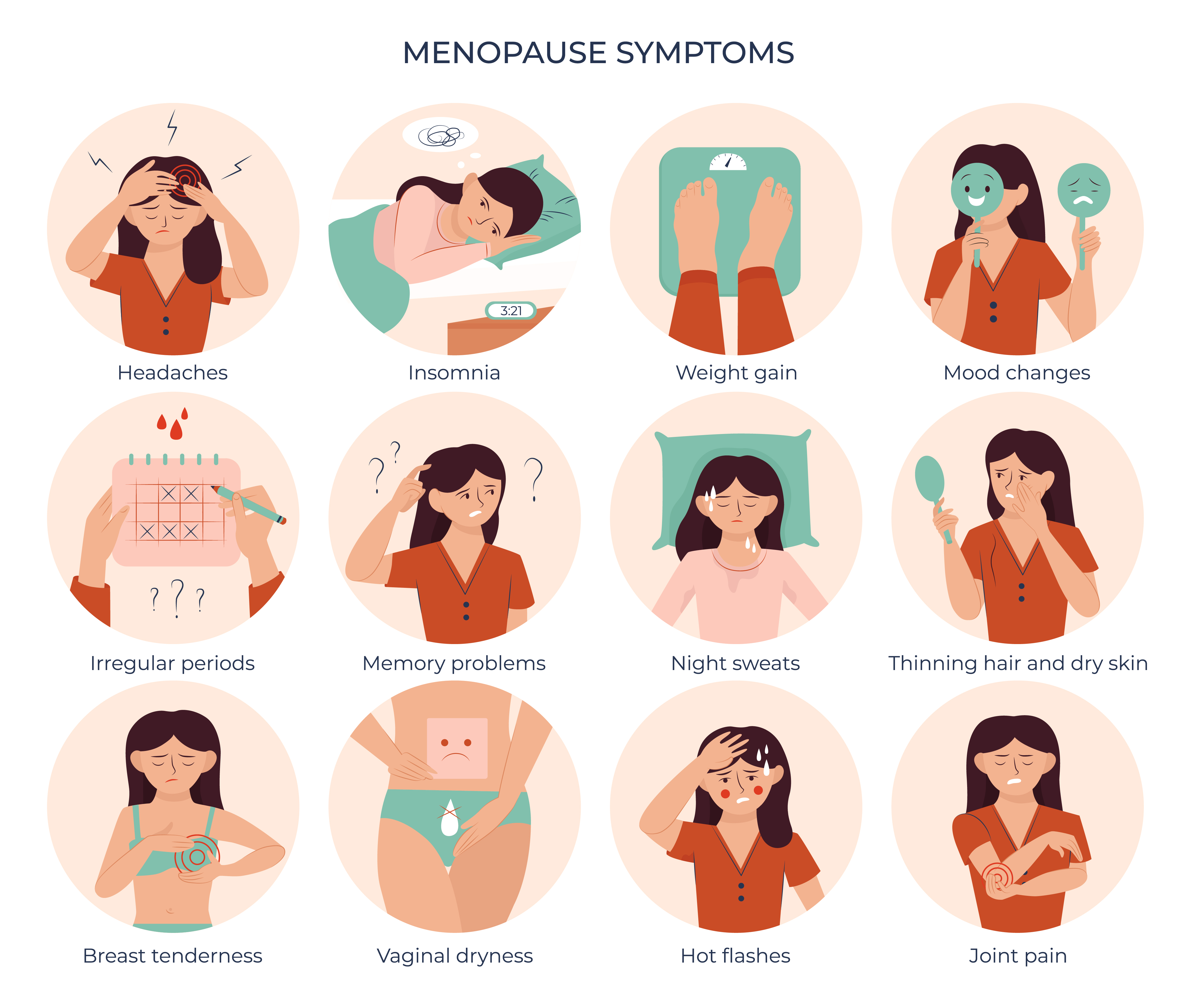
The symptoms in the previous section get talked about. These don't. Joint pain, palpitations, worsening PMS… they tend to get written off as stress, aging, or something else entirely. If you've been collecting vague complaints that don't quite add up, hormones may be more relevant than you think.
Estrogen has anti-inflammatory properties, so when levels drop, joint pain and stiffness can show up. Sometimes before other more "classic" perimenopause signs do. Many people attribute this to aging or overuse without connecting it to hormonal changes.
Feeling like your heart is racing, fluttering, or skipping beats can be alarming. Heart palpitations are among the symptoms frequently associated with a perimenopause diagnosis in those who consult a healthcare provider, but they're rarely discussed in general perimenopause education. If you're experiencing frequent or prolonged palpitations, it's worth getting evaluated to rule out other causes.
Lower estrogen affects collagen production, which can lead to drier, thinner skin, more noticeable fine lines, and changes in hair texture or density. Nails may become more brittle. These changes tend to happen gradually and are often chalked up to "just getting older."
If your premenstrual symptoms have gotten noticeably worse (like more intense cramps, more severe mood changes, more bloating) perimenopause may be the reason. Hormonal fluctuations can amplify PMS symptoms significantly, and for those who already deal with PMDD, the perimenopausal transition can make it considerably harder to manage.
One of the most common points of confusion is figuring out where you actually are in this process. Perimenopause and menopause are often treated as the same thing, but they're not, and the distinction matters for how symptoms are evaluated and what treatment options make sense for you.
During perimenopause, estrogen and progesterone levels are actively fluctuating, often rising and falling in ways that can be unpredictable month to month. During and after menopause, estrogen settles at a consistently lower level. The transition period is often more symptom-heavy than menopause itself because of those fluctuations.
Testing hormone levels is generally not recommended as a first step, because hormone levels fluctuate significantly during perimenopause and a test on one day can look very different from a test taken a week later. Most providers diagnose perimenopause based on symptoms and menstrual history rather than bloodwork alone. Testing may be useful if you're under 40 with no periods, or if you're on hormonal birth control that masks cycle changes.
Short answer: yes. This catches a lot of people off guard, especially when periods have become irregular or infrequent. Unpredictable cycles can make it easy to assume your fertile window has closed, but that's not a safe assumption to make without more information.
You can still get pregnant during perimenopause, even if you miss your period for a month or several months. During this transition, you may still ovulate for some months, and it's impossible to know for certain when that will happen. The World Health Organization states contraception is recommended to avoid unintended pregnancy until after 12 consecutive months without menstruation.
Irregular periods can make it easy to assume pregnancy isn't possible, but that assumption carries real risk. If you're not planning to conceive, staying on a reliable contraceptive method matters just as much in your 40s as it did in your 20s.
Contraceptive needs shift during perimenopause. Low-dose hormonal birth control can actually serve double duty here, like preventing pregnancy while also helping manage perimenopause symptoms like irregular bleeding, hot flashes, and mood changes. An IUD, progestin-only pill, or hormonal patch may also be appropriate depending on your health history.
Twentyeight Health's licensed providers can help you figure out which option fits where you are right now. Check your insurance coverage to get started.
There's no single fix, and what works well for one person may not do much for another. That said, there are real, evidence-backed options across the board—from hormonal treatments to lifestyle changes—and most people find meaningful relief with the right combination. Here's what's actually available.
Low-dose combined hormonal contraceptives can ease irregular periods, hot flashes, and mood instability during perimenopause. For those who are not candidates for estrogen-containing contraception, there are progestin-only options as well.
Hormone replacement therapy (HRT) is another option worth discussing with your provider, particularly if symptoms are significantly affecting your quality of life. HRT works by adding back estrogen and progesterone to help relieve perimenopausal symptoms, with dosing adjusted based on symptoms rather than lab values. It can be used in both post-menopause treatment and during perimenopausal transition too.
Several lifestyle factors have meaningful evidence behind them for symptom relief. Regular physical activity helps with mood, sleep, and metabolic changes. Reducing alcohol can decrease hot flash frequency and improve sleep quality. A diet rich in whole foods and phytoestrogens (found in soy, flaxseed, and legumes) may help buffer some hormonal fluctuations. Stress reduction practices—whether that's therapy, meditation, or simply protecting time to rest—are not optional extras since they directly affect how your body processes hormonal shifts.
You don't need to wait until symptoms become unbearable. If perimenopause symptoms are affecting your sleep, your relationships, your work, or your sense of wellbeing, that's a good enough reason to reach out.
Twentyeight Health is in-network with 100+ insurance plans and serves people across all 50 states. Our licensed providers can talk through what you're experiencing, review your options, and help you put a plan together that works for your life and your body.
Perimenopause looks different for everyone. A Twentyeight Health provider can help you figure out what's happening and what to do about it. Check your coverage and get started today.


.png)